(Final part)
Helicopters know how to trash up the neighborhood. Rotorwash is some of
the worst air to fly through, especially when landing. A hovering chopper is
bad enough; it spreads rolling, crashing waves of turbulence in all directions.
But when the helicopter moves ahead in ground effect from a hover, a new blast
of unpredictable swirls and curls wash behind the ungainly machine. And when
there are three of these colossal egg beaters tearing up the cushion of air
over your intended landing spot, you're in a bad pickle.
I knew what was coming. Invisible tornados were waltzing with each
other on that runway, waiting with twisted sneers for a little yellow and white
airplane to join the mix. The fuel gauge still showed two gallons. I didn't
know if that was accurate or not. I suspected it was not, but I didn't waste
much time deciding to tackle the rotorwash rather than risk running out of fuel
on the go-around.
The first buffet began at about 30 feet then got worse. That's about
when I normally check airspeed for the last time. I worked hard at correcting
the wing-rocks and the nose-yaws, but I sure didn't want the nose moving up or
down. I focused on touching down at a point I picked ahead and tried with some
success to nail the pitch attitude. As the runway came up I tried to level out
for a wheel landing, but the plane ballooned up and rolled right. I added power
and lowered the nose slightly, trying to keep the nose aligned with rudder and
aileron. It was like trying to land in a cross wind that shifted from left to
right and back, again and again.
The airplane finally contacted the runway about half way down in a firm
three-point attitude, heading for the edge, and then went airborne again. The
second touchdown (if you can be generous enough to call it a “touch down”)
happened with the nose pointing to the right side of the runway. Again it went
airborne, yawed and tried to roll. The rolls were the easiest to stop. The
yawing and pitching were demons.
At last the plane plopped down and stayed down, though I had to correct
with rudder first and then brakes to keep it on the runway. I turned off
sweating bullets--full metal jackets. I taxied to the FBO, shut down and went
in for a long gulp of ice water. Then I went out and watched the lineman gas
the RV up. He stopped at 30 gallons. I had 8 gallons left—almost an hour of
fuel at economy cruise. I had planned for ten, but eight wasn’t bad.
I went back in to pay the bill and saw some Army aviators in there.
“Did you guys fly the Black Hawks in?” I wanted to explain why I had to have
that runway.
They turned and looked at me with menacing, displeased faces. Uh oh, I
thought. They’re going to hose me for breaking up their formation. One spoke
up. “Those are Apaches, Sir! Not Black Hawks.”
I felt like a tin horn. These guys didn't mind having to vacate the
runway for me, but they were pissed at my insult. It was like calling a fighter
pilot a cargo jock. I backed away uttering my sincerest mea culpa.
Back out at the plane a couple of corporate pilots with white shirts
and epaulettes studied the Six. (Their Challenger was parked beside my pocket
rocket.) I phoned home to tell the family about what time I would get in. I
told them I would update them with a text when I got in the air. Some of them
were following me on Flight Tracker.
Taxing out I told the tower controller about the hour of fuel I had
left. I didn't want him thinking I actually did land near empty. The Feds
require that you plan flights with a 30 minute reserve for visual flights. It
might appear to him that I had violated that. He said he was glad it all worked
out and thanked me for entertaining him with that landing. But he added that I
should have told him sooner about the fuel concern. Fair enough.
I took off at about 3pm for the final leg, which would become one of
the most unforgettable flights I've have ever had. I climbed to 7,500, which is
where AOPA's Fly-Q program said was the most optimum for tailwinds, but I found
I only had about a five knot push. I set a GPS direct course for 3M5 (Moontown
Airport), engaged the autopilot and altitude hold and relaxed. It was nice to
gaze down at plush green farmlands and forests after the long haul over the
stony dry country.
About half way across southern Arkansas I flew into a netherworld that
teemed with swarms of billowing cumulus, their bottoms flat, their tops
reaching up into air too thin for me to breathe. I knew that to descend below
them would put me in a bad ride due to bumpy air. Between them though, the air
was as smooth as a baby's butt. I began weaving around them by using the turn
knob on the autopilot—a disgustingly effortless way to fly an airplane.
It was a delightful ride. I had done this before in jet aircraft for
brief times, but had never cruised for so long amidst these towering beasts
turning left, then right, maintaining a rough line of progress toward the
destination and still seeing landmarks below. I marveled at how quick the
brilliant clouds flowed by my wingtips. I had flown many a fast plane but never
owned one that would put away the real estate like this one. The RV had messed
with Texas, crossing its longest axis in four hours.
The radar controller at Memphis Center called me. “Seven Sierra
Whiskey, it looks like you're deviating around clouds. That's fine, just let me
know if you change altitude.”
Sometimes it's good to have Big Brother watching you. From time to time
he pointed out other air traffic in my vicinity, and weather too. “Seven Sierra
Whiskey, there is an area of heavy precipitation at your one o'clock, ten
miles.” Due to the marvelously clear air between the white titans I had already
seen the storm with its blue rain shaft below it, and was steering for its
north side.
The previous two legs had shown me that the RV doesn't come down very
fast without its flaps out, so you need to begin the descent a long way out. I
knew better than cutting the power to idle, which might shock-cool the engine,
so I reduced power to about half the manifold pressure I had used for the
cruise and trimmed the plane for a gradual descent. Soon familiar landmarks
came into view and I checked in with Huntsville Approach Control. I flew past
their big airport (one runway is 13,000 feet long) and saw the mountains ahead.
I knew Moontown was in the valley, just the other side.
My butt was sore, but I knew I had plenty of fuel left (the fuel
quantity gauge was behaving itself now) so I decided a fly-by of my house was
in order. I live not far from the airport on a hillside with nothing but
farmland out front, so it doesn't annoy anyone to make a fly-by. I glanced out
to the side. The porch and yard were empty—nobody watching. They must be at the
airport I thought. I banked around and in a minute I was in the traffic
pattern. The wind was calm and the sun low as I took the Six down the runway,
wide open. I glanced aside toward the hangar area. Nobody there. Strange.
I pulled up, went back around and plopped 7SW down on the grassy
runway, with only a small bounce, turned off and rolled up into my hangar port.
I shut down the engine, sat for a couple of minutes and climbed out. I looked
around. It was a head-scratcher. Not a soul stirred. The airport was empty of
life.
As I unloaded the plane, four vehicles came up—one each for wife and
three sons. They were shaking their heads, wondering how they had missed the
arrival with all the information they had. Scott was running errands with a
friend when he checked Flight Tracker. “Oh my gosh, he's almost here!” he told
his buddy. “That cat is covering ground!” He rushed out to the field but, like
the others, had overestimated the arrival and was too late. They were all
disappointed. They had wanted to see and video an arrival fly-by.
Arriving without the family fanfare was somehow fitting. I had been
alone with that plane for many hours, and now it and I made a lone arrival. It
was all okay.
Thus began 7SW's residency at Moontown Airport where it would join the
company of five other RVs, and I was to become the beneficiary of those planes'
owners' vast pool of knowledge. As to the dreaded “rocket rod,” I would
discover that many RVs had them, and I would keep mine—at least for a while.
Fetching the RV was an adventure of sorts, made possible by some first-rate
people in Arizona who helped me along. And it was the culmination of a long
winter of soul-searching—of not knowing what I should do; of wondering whether
to buy another plane or retire from general aviation; of mourning my friend's
death; of going to bed and waking up with visions of the Yak shuddering in an
accelerated stall, then diving into the ground.
I had finally made my choice. Sport aviation was in my blood, and a
little yellow and white airplane had flown by and gotten tangled on my heart
strings. I had a lot more learning ahead to get to know 7SW, but I knew one
thing for certain. This was what George would have wanted me to do.
 |
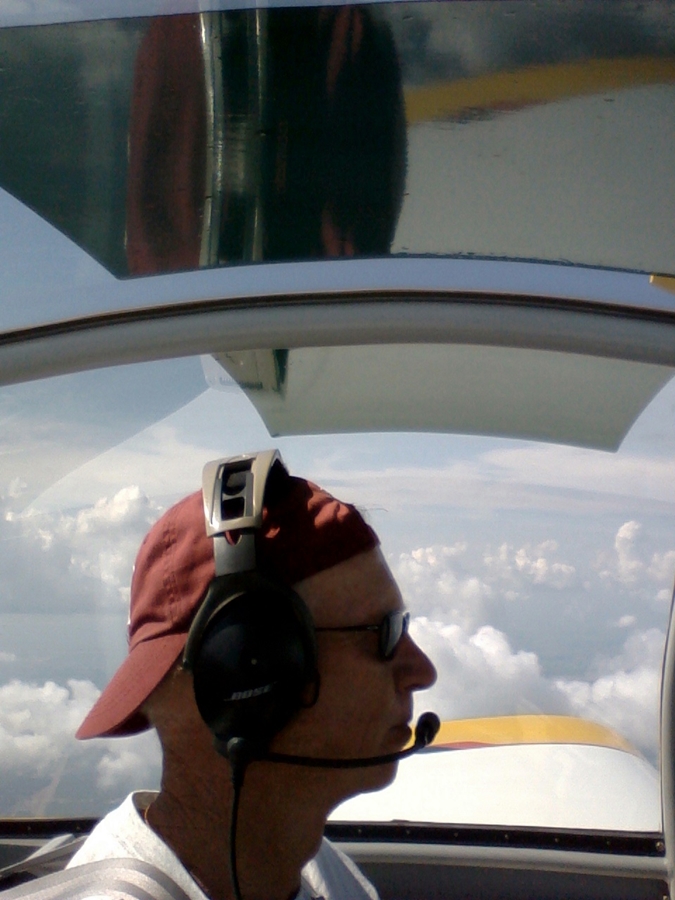
| The sun to my back was making me an even bigger redneck than I am. |
 |
| GPS makes you lazy. 167 knots at 65% power makes you happy, happy, happy. | | | | |
|
|
|
|
|
 This was one of several rainbow bedecked rainshafts I skirted over Mississippi.
7SW in her new lair.

 everywhere, but taxiing
around Heathrow (identifier LRH) is easy as eating kidney pie. (Okay then,
lemon pie.) Why? A row of green lights embedded in the tarmac suddenly light up—just
for you. “Follow the green,” the ground controller tells you. Nothing else. No
confusing instructions. Just follow the green-brick road. It’s like a train on
the tracks. (Alas, some parts of LHR are not yet equipped for this.)
everywhere, but taxiing
around Heathrow (identifier LRH) is easy as eating kidney pie. (Okay then,
lemon pie.) Why? A row of green lights embedded in the tarmac suddenly light up—just
for you. “Follow the green,” the ground controller tells you. Nothing else. No
confusing instructions. Just follow the green-brick road. It’s like a train on
the tracks. (Alas, some parts of LHR are not yet equipped for this.) everywhere, but taxiing
around Heathrow (identifier LRH) is easy as eating kidney pie. (Okay then,
lemon pie.) Why? A row of green lights embedded in the tarmac suddenly light up—just
for you. “Follow the green,” the ground controller tells you. Nothing else. No
confusing instructions. Just follow the green-brick road. It’s like a train on
the tracks. (Alas, some parts of LHR are not yet equipped for this.)
everywhere, but taxiing
around Heathrow (identifier LRH) is easy as eating kidney pie. (Okay then,
lemon pie.) Why? A row of green lights embedded in the tarmac suddenly light up—just
for you. “Follow the green,” the ground controller tells you. Nothing else. No
confusing instructions. Just follow the green-brick road. It’s like a train on
the tracks. (Alas, some parts of LHR are not yet equipped for this.)