Wednesday, July 15, 2009

I, the Guinea Pig

A guinea pig is a cute little rodent commonly used in lavatory tests. But in the world of commercial aviation a guinea pig is any pilot who first ventures up to test questionable weather before others takeoff. And thus, so are his trusting passengers. But sooner or later somebody has to do it, lest the airport remain at a standstill. Last week at Denver I became the pig, or rat, or whatever the thing is.
  There were a dozen planes lined up behind us. We were number one to takeoff, but I had an uneasy feeling about the threatening weather. A gigantic thunderstorm inched its way eastward south of the airport. Its arms of turbulent cloud weaved overhead like an octopus’s probing tentacles. But the main body of the beast was ten miles away, which gave us plenty of room to turn away from it.

Confident that his ride in the tower cab would be a smooth one, the tower controller cleared us for takeoff. I lined up the 757 on runway 17R, but only for a look/see. Our radar verified the storm was a safe distance away, however the gunmetal clouds billowing and curling overhead boded an atmosphere ripe for windshear.


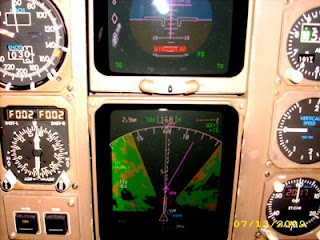
Suddenly, with the urgency of an air raid klaxon, a voice blared at us: “WINDSHEAR AHEAD! WINDSHEAR AHEAD! WINDSHEAR AHEAD!”
The voice was that of “Bitching Bob,” our own plane shouting to us. I looked down at the electronic horizontal situation indicator. A splotch of bright red marks sat two miles ahead of us. Its unspoken message: Fly through here lads and they'll weep at your wake

 
I told Mike to inform the tower. The busy tower controller, who was managing operations on three runways said, “Who’s reporting windshear?” He sounded annoyed, as if the news was now severely complicating his life. Or was he agitated that his own windshear detection system had not seen what our plane’s gear saw? 
But seconds later he too got on the bandwagon. “Okay, our equipment sees it now. ATTENTION ALL AIRCRAFT. MICROBURST ALERT! DENVER, RUNWAY 17 RIGHT!”\
Long minutes passed as we sat poised for take-off. I tried to relax but couldn’t. No pilot enjoys sitting on an active runway, unable to check his six. We watched and listened as a 737 approached Runway 8, which was perpendicular to us. “That guy ought to have his head examined,” said Mike, a seasoned Naval aviator. I agreed. As if hearing our comments, the 737 pilots wised up and went around. 
Many jets were waiting behind us. We could see them to our right front on the parallel taxiway. I knew they were watching to see what we would do. Windshear is a fickle thing. It comes. It goes. When would we roll? We waited. They waited.
 “You want to take precautions?” Mike asked.
“Yeah!” I said. “We’ll use maximum thrust. And work me up an increased Vr.”

Mike nodded and calculated a rotation spe
ed based on our maximum runway limit weight. Using the extra momentum of a longer takeoff roll we would slingshot ourselves into the turbulent sky—the theory being if we hit windshear we should have the energy to punch through it. But we still had to wait until the warnings subsided.

I thought about the Pan Am flight at New Orleans in 1982. They took off with a thunderstorm nearby and hit a microburst. They all died. Nobody knew then what a microburst was, mu
ch less how to predict it and prepare for it. A microburst happens when a thunderstorm spits its windy wrath straight down. In the aftermath of the New Orleans disaster the excellent predictive windshear system embedded in the nose of our jet was developed. It uses Doppler radar to detect horizontal wind movement.

Windshear reports began to flow in from other parts of the airport. On the west side the shear was 50 knots. I looked at the windsock bes
ide our runway. It hung limp―not enough to fly a kite. Creepy. Finally the warnings stopped—both ours and the towers. Tower cleared us to takeoff.

At that very moment we heard a “ding,” the forward flight attendant calling. Mike let out a big “Phsew! What now?”
I answered the call. A passenger had to go to the lavatory―couldn’t wait. I couldn’t believe what I was hearing. The whole airport was waiting for us, and some guy had to tinkle. I said, “No way. He stays down!” But before she hung up her handset I revaluated. “No. Wait! Okay. Tell him to get it done QUICKLY and report back when he’s seated!”

The tower wanted to know why we weren’t rolling. Mike told them. I could almost hear his frustrated sigh, along with the chuckles of the other pilots waiting.


The sky ahead boiled and flowed with menacing tendrils emanating from the storm but the windshear warning stayed silent. I worried our window of opportunity might close.
Finally another DING. He was down. I kicked the parking brake off and shoved the two big Pratts to maximum power. The roar of 75,000 pounds of raw thrust catapulted us forward. We heard a clattering crash of metal in the galley behind us. The flight attendant had not secured the galley drawers and the acceleration emptied them onto the floor. We ignored it and concentrated on the takeoff.

The wind sock kicked out with a direct crosswind as we rolled. I held the yoke into the wind but not too much, less the spoilers, which aid the aileron function deploy and impede our acceleration. The speed picked up fast but hung up at 90 knots for a few troubling seconds, then increased again. I concentrated
on the white stripes racing at us while Mike hunched over staring with shifty, suspicious eyes at the engine instruments watching for a malfunction. I waited for the windshear warning. I was ready. If it came prior to V1 I would abort. 

A high speed runway abort is one of the most dangerous maneuvers airline pilots are called on to do. The decision has to be made instantly, the physical reaction must be instantaneous and it must be done right. A hundred and eighty-five breathing, frightened bodies back there would get slammed forward against their seat belts while hearing the engine reversers belch a hellacious roar. Ever heard the old saying ‘There are no atheists in a fox hole’? I submit to you that there are also none riding out a high speed abort.

The expansion joints in the concrete thumped under our nose wheel like machinegun fire, ever faster and faster. Finally, Mike said, “VEE ONE.” I kept the nose down gathering even more precious speed, far more than we needed under normal circumstances. Then, “ROTATE!” I gingerly raised the nose, not too much—didn’t want to dissipate energy.
The runway fell away and our ride turned smooth. Mike raised the gear, then the flaps. We turned east, away from the storm.

As we climbed out I wondered what the guy who had to pee thought when the engines exploded with a tearing roar, kicking us ahead like a lit afterburner, just as his butt hit his seat.


And another thought: I distinctly remembered hearing a quick transmission during our takeoff that must have come from one of the aircraft waiting behind us. I was sure is sounded like “Oink oink!”


The other planes watched us climb away. One by one they fed onto the runway and followed their guinea pig into the restless sky

Tuesday, July 7, 2009

Aiming for the Dawn

It flashed across our nose like a home run hit out of Heaven’s ballpark. A searing, white-hot dart streaked across the black sky and burned like a tracer bullet through the starry night, plunging below the southern horizon in a heartbeat. I wondered how many denizens of the dark planet sprawled below us saw it.

Frenchie didn’t see it. He was heads-down, reading. His sidewall light spewed a yellow cone onto the boating magazine in his lap. The red and white reflections of the cockpit flickered, danced, and flowed in the lens of his reading glasses. I considered describing the vivid meteor I just saw but thought the better of it. Frenchie would only have grunted and glanced outside, then returned to his reading.

I looked ahead and took stock of the starscape. Constellations hung above us like clusters of glistening celestial grapes waiting for a colossal hand to reach for the plucking.


The radio crackled with a voice far away in a dark room. I imagined the glow of the radar scope casting a green sheen on the man's face as he keyed his mike and gave us a new frequency followed by a lethargic "G'nite."

We were the San Diego-Dulles red eye flight, eastbound over the desert southwest. I saw only a scattering of feeble, lonely lights speckled across the beneathworld. The people were sleeping down there―farm and ranch families. Even if some of them were lying awake, pondering the coming workday, they wouldn’t care that we were sailing high over their roofs. I gazed down and remembered a question that was once asked of me.

I was a first officer on the DC-10. Jim Blue, the captain, was a scab. He had crossed the picket line in the 1985 strike and was now numbered among the shunned. He didn’t talk much. He wasn’t used to it. Every time he came to work, since he scabbed, he dined on cold shoulder in the company cafeteria and felt scornful stares piercing his back. Once while we cruised high over the Midwest, Blue asked me an odd question. “What do you see when you look down there?” I looked down at the vast checkerboard of cultivated farmlands stretching from horizon to horizon. I looked back at him and shrugged. “Farms.”

Blue went silent again and looked out his side window, as if pitying me for my shallowness. He gazed down a long time. I wondered what he saw that I didn’t. He finally resumed his perpetual straight ahead stare, then muttered something. I didn’t understand it. I asked him what.

“Hard work,” Blue said. “Hard work is what I see down there.”

Blue had long since retired, and now as a captain I too occasionally felt a yearning to ask my first officer profound questions. But not that night. Frenchie would only grunt and shrug.

I looked down. Surely none of those hard working ranchers would be up that time of the night. Yet if the winds were calm enough our jet noise would trickle down to the ears of those who might be standing outside, looking up and watching for our starlit contrails. What might they be thinking about us? Hard work?

Hardly.

Maybe an amateur astronomer sat down there searching the Arizona skyscapes for new comet. Or perhaps a farmer-philosopher stood gazing at the heavens pondering his place in the scheme of things. If so, they would be able to see our contrails easily. Earlier I watched another jet a thousand feet below angling across our course. In the streaming starlight I could clearly see the long white ribbon of water vapor stretched out behind it. In times past we would have flashed landing lights at each other―a high silent salute. Most pilots didn’t do that anymore. I wondered why.

Things had changed. Maybe our profession had too quickly gone from a grass roots cadre of old sentimentalist's to new legions of dispassionate button pushers fresh out of air colleges, without a chance to pass tradition along, or worse, without an inclination to do so. I had begun to notice the younger pilots never referred to the jets as her or she. To them the plane was simply “it.” That seemed
spiritless. The creature I was riding through that ebony sky was alive. Her heartbeat was a pulsing electronic purr and the hissing slipstream her breath. She was a Boeing 757. Pilots at other airlines called her the "Seven Five." We call her the "Fifty-seven."

I wasn’t sure the pragmatic Frenchie felt the same way about planes’ having lives of their own. He was a retired Marine light colonel who had flown Phantoms and Hornets. And I was pretty sure he had no patience for imagination, although I once heard him call our jet a pig, back when he and I were on the 737. After that, the 737 became the "Pig Jet" for me. But whatever Frenchie's displeasure was with the Pig Jet, even that insult was a veiled confession that he regarded her as a creature, not a machine.

Frenchie was a good pilot. He had been a squadron commander, but here in the quasi-military world of airline flying he had rebelled against authority. He thumbed his nose at the airline’s uniform dress rules; he wore black loafers instead of the required plain-toed shoes and had long ago shed his hat and dress jacket. He preferred wearing a non-descript overcoat. The only way anyone in an airport would know Frenchie was a pilot would be to see him towing his travel bag with his sticker-studded pilot flight kit bag riding piggyback on it.

Like me, he was also a brooder. He would sit for hours saying nothing much―only a grunt, a nod, a chuckle. But over beer and burgers at the layovers he gushed with garish stories of his days with the Corps and his old Marine buds, laughing at the memories with heavy cackles. When the stories were over the brood settled back on him. I knew he was wondering if the best was behind him.


With an hour left in the trip my eyelids grew heavy. My gaze dropped from the star-studded windshield to the glowing instruments, as familiar and contented a sight to me as my family’s faces. As fatigue crept into my eyes the instruments blurred and merged.

I shook it off and remembered Charles Lindbergh’s compelling story of his lone Atlantic crossing 80 years ago. He desperately battled the fatigue demon while his hands and feet struggled constantly to keep his plane under control.

He had nine clattering pistons on his nose whirling a propeller carved from a tree trunk, a whiskey compass, a mariner’s map, and only himself, for 33 hours. While fighting off sleep and the death it bore with it, he still had to fly the plane and navigate. Somewhere over the middle of the Atlantic, Lindbergh, for the first time in his life unsure of himself, stopped trying to guess the screwy winds, the drift angle, the ground speed, and the true course. He resolved simply to hold to an easterly course and hope for the best.

I wondered if Lindbergh, an admitted doubter, ever trusted any power other than his own. But I do know that as the earth turned toward the sun he steered for the only direction he knew his salvation lie―the dawn.

I too was headed east. I could see the ebony expanse ahead taking on a blue hue―the sun driving back the night. Soon the welcome sight of the Appalachian ridgelines and a new day would scroll into view. I wondered what the next day, year, and decade would bring to this once proud profession. I had gotten in on it just as the golden age of the airline pilot was ebbing. I had seen the ugly spoils of labor and management wars. I saw compensation steadily erode as low cost competitors and regional feeders hired people eager to haul trusting passengers for peanut wages, the ink on their commercial pilot licenses still wet.

I watched, numbed, as suicidal zealots cut the throats of my co-workers in their cockpits, turned our jets into missiles, and butchered thousands of innocent people. I saw the industry fall apart in the aftermath, changed forever.

In those dim days after the terrorist massacre, when we all feared for our country, family and jobs―as we still do―I overheard a conversation in the operations room. "What do we do?" a despondent young pilot asked his buddy. The other one replied, "We do three things: Trust God. Trust God. Trust God."

In the wake of the wasted lives and shattered dreams of 9/11, the energy calamity, and the economic meltdown, I constantly wonder what the future holds for me, nearing the end of my career, and for the young ones who never flash their lights, never wear their hats, nor ask the profound questions. I have no idea what lies ahead. I just try to remember the "three things" and―like Lindbergh―hold a steady course and aim for the dawn.

Friday, June 26, 2009

Round and round it goes...

On the way in to Kansas City flight operations we passed a mass of people waiting to get on our jet going to Denver. They pecked at Blackberrys and listened to I-Pods behind dull eyes. They had paid to get there safely. They expected it and that’s all that mattered to them. I’m cool with that.

I knew there were thunderstorms threatening Denver (DEN), so I made sure we had enough fuel to divert to Colorado Springs (COS), plus some extra in case we had a ground delay.

You guessed it, as we reached the end of the runway the tower told us DEN was in a ground stop. We were to expect over an hour delay. I looked over at my first officer, Mike. He was shaking his head. We couldn’t afford to sit there that long cooking fuel. Our APU was deferred inoperative. We decided to wait 15 minutes, and if the ground stop was still in effect we would go back for fuel, but that would incur still another delay. Fifteen minutes later the tower cleared us for takeoff. We smirked at our excellent decision. Where does the airline find such [lucky] men as us?

Then, approaching Denver, the dreaded call from Center: “Are you ready to copy holding instructions?” Upon hearing that question all airline pilots’ antennas go up. They know they will be earning their pay that day. Denver was covered in thunder bumpers.

We got our hold instructions. They included an expectation of holding for 50 minutes at the Oathe fix. We checked our fuel. Could we hold for 50 minutes and then go to Denver, shoot the approach, and still go to Colorado Springs and have 30 minutes fuel left? We decided we could. We let the jet fly the holding pattern on autopilot and while the cloudy world rotated around us we checked the weather at COS. A thunderstorm gust front was moving through. Now the stakes went up. Our alternate was socked in.

Our senses went into override. We got weather for Pueblo (PUB). It looked good. But would there be enough fuel to hold 50 minutes, shoot an approach at Denver and go to PUB? We didn’t know. We needed to know how much we would burn from Denver to Pueblo. We guessed 4,000 pounds. We asked our dispatcher, via data link, to give us our landing performance data at Pueblo. He did. We were good to land there if necessary. But we didn’t have the gas to hold 50 minutes.

But then, wa la! Colorado Springs reported frontal passage. We went back to plan A. We would hold for the full 50 minutes. But then Center told us the wait in the holding pattern had been extended to an hour and a half. That did it. We told them we were bolting for COS. They cleared us directly to it.

Just as we were approaching the COS airport, the Center said Denver was good and we could go direct to it if we wanted. We looked at our fuel. We had burned a bunch of it maneuvering at low altitude. What if we didn’t get in at DEN? Was there enough fuel to get back down to the Springs? We decided there was. We turned north to DEN. That’s when we heard the low level wind shear warnings at Denver.

So, what to do now? Turn back immediately to COS, or continue to DEN and “have a look”? We decided on the latter. I got out my checklist and reviewed the wind shear escape procedure.

Turning on final at DEN a flight ahead of us reported mild wind shear on his approach. We didn’t get it. The landing was smooth. We blocked in and every one got off and switched on their Blackberrys and donned their ear pods. They didn’t give any thought to what we had gone through. They didn’t need
to. They paid to get there safely. They got that, and I’m cool with it.

...and where its stops, nobody knows.

And now, this week's mind boggler:
Look at this pic I took out the front. We are high up, cruising east out of Denver with the sun setting behind us. What causes these unusual "sun rays"?

Monday, June 8, 2009

A Pathetic Confession

I wondered why so many people would swarm into an airport at such an unsociable hour. The sun wasn't even up. Decent folks were supposed to be still in bed. But the security screening line at the Tampa airport teemed with humanity. Our crew flashed our IDs to a sleepy uninterested agent and walked past hundreds of people, dutifully lined up for what they believed was a necessary and thorough checking over of their bodies and bags for items of evil potential.

We assembled at the front of the line and started the numbing drill of emptying pockets and hoisting bags onto the belt. While I wa
ited my turn I noticed a worker coming alongside the screening portal pushing a large cart piled high with material. He appeared to be a repairman or construction worker.

His cart contained boxes and large storage cans. He circumvented the screening station, pushing the cart through the exit portal. T
his didn’t surprise me; anything too big to go through the x-ray machine normally went around it and was visually inspected. After pushing his cart through, and as I expected, the worker came back around and got in line for screening.

He got in ahead of us crew members because he only had to empty his pockets, while we took longer. He quickly went through the walk-through screener without a problem.


On the other side of the security screen I noticed a man wearing the emblem of the security screening contractor on his jacket, standing with his hands behind his back smiling and observing the activities at the two screening stations. This I took to be the shift supervisor. I watched to see how closely he would inspect the cart.

The supervisor smiled at the worker, nodded and said something, a greeting perhaps. Obviously they knew each other. Then I stood
dumbfounded as the worker took his cart and pushed it along his merry way without the screening crew giving it so much as a glance. My blood started to boil.

After collecting my stuff on the other side I approached the supervisor.


“That work cart that just came through he
re…”

He smiled and nodded. He would have made a great Walmart greeter.


“I was watching. You didn’t inspect it. Aren’t you supposed to do that?”


He shrugged. “Well, yes. I guess I should hav
e.”

Then he just stood looking at me with a dumb grin. I fumed. I had to get a hold of myself. I felt like grabbing the man’s neck. “DON’T YOU KNOW HE COULD HAVE HIDDEN WEAPONS IN THOSE CONTAINERS?” I ba
rked the question through my teeth, trying to constrain myself.

He looked at the floor, then back I me. “We know him.” He shrugged again. “He comes through here every day!”


My glare bore a clear message: This isn’t over!

I hurried to our Tampa station operations office and asked where the station manager was. The company used its station managers as local security coordinators. I was told she wasn’t in yet. I called airport security a
nd told them what I saw. Then I went about my business of flight planning and getting the plane ready to fly.

When I landed in Chicago later that morning my cell phone rang as soon as I turned it on. It was the FAA. The agent said he had reviewed the surveillance tapes. He saw the cart go through, saw the security crew ignore it, an
d saw me talk to the supervisor. The FAA and the airport authority had suspended the security crew pending an investigation. He told me they considered the incident serious and that I was to expect a call from the FBI.

Later that day when I landed in Denver m
y phone rang again when I turned it on―FBI. They were intensely interested in what happened and wanted to schedule me for a deposition. The agent told me to expect a call the following week. The day was September 5, 2001. I never got the call.

The security supervisor's pathetic confession to me (“I guess I should have.”) is one that an entire nation may well have said of its complacency and carelessness—and come to profoundly regret.

Wednesday, May 27, 2009

Reflections: Scouted

About half way to Denver from Chicago we heard a ding, a flight attendant calling. I was expecting a drink offer. As I reached for the handset, my first officer, Tom, said, “I’ll take water.”

But the lead flight attendant―whom at this airline we call the “purser”―immediately said, “I’ve got to see you, NOW!”

I unlocked the door and she came into the cockpit with tears rolling down her cheeks. She was fairly young and I instantly concluded that some jerk had intimidated her.


She said four men got up from their seats in the coach section and came to her work station at the forward galley―next to the cockpit. They were Arabs, or at least looked and sounded like middle-easterners.

They asked her if they could visit the cockpit. She told them it was not allowed. One of them asked her if the door was locked. She said yes and asked them to go back to their seats. But they lingered.


They peppered her with more questions,
angering and upsetting her. They asked about the door, the rules, the procedures and even the consequences of entering the cockpit. Finally she told them to sit down or she would inform the captain and have the authorities meet the plane, which by then she had decided to do anyway. They went back to their seats.

She sat telling us this, sobbing and wiping her eyes. I assured her we would report the incident and ask for law enforcement at Denver. She thanked us, peered through the peephole to assure no one was standing near the door and went back.


“What do you make of it?” I asked Tom.

He shrugged. “Sounds like they may have been messin’ with her. She said they were young guys. But we ought to report it.”


We sent an ACARS message ahead describing what happened. When we blocked in at Denver, instead of law officers an unarmed female customer service supervisor met us and asked more questions about the incident. She wrote down the men's seat numbers and said she would look up their names. By the time she finished taking her notes all the passengers were gone.

Tom and I looked at each other and shrugged. That weak response was about what we expected. Little or nothing would probably
be done.

Then came September 11, 2001.


A couple of months later I saw Tom in operations. He rushed up to me. "Remember the flight when the four Arabs came up and scared the flight attendant?" I nodded. I had not thought about it until then. "They were scouting us!" Tom said, his bottom lip curling with indignation. "They were gathering informati
on. That's what the sorry bastards were doing!"

I think he was right.


Stay tuned for the next post which will describe an even more bizarre thing that happened to me the week prior to that awful day.


Tuesday, May 19, 2009

A Jolly Petrolly

What's a "Jolly Petrolly" you say? That's British slang for a happy little flying excursion, usually performed on a Saturday afternoon and including a stopover at another airport for lunch. Actually a South African friend told me that.
The big news in aviation this past week was the NTSB hearings on the Buffalo NY crash last winter of Colgan Air flight 3407. You’re all familiar with that.

The news media is demanding why Colgan didn’t pay the pilots more, train them better and monitor their rest patterns. There’s also some talk about the captain being inept with a history of checkride failures, somehow having slipped through Colgan’s hiring screen. If history indeed repeats, this is all plausible.

Every few years (on the average, I’d say 10 years, or so) we get a similar crash of a small air carrier plane. The captain has a history of failure, the first officer is too young and inexperienced to be of any value, and they are both fatigued due to a heavy work schedule. Oh yeah, and they are both paid peanuts. And every time it happens the news commentators go up in arms.

Then we all forget and nothing gets done. Sound familiar? Remember the national resolve after 9/11? It dissolved.

Let me say this, though. I commute every week to Washington on a 50 seat regional jet and, for the most part, I’m satisfied that the guys in front are competent. You can be too. But they need to be paid better for their level of responsibility. Jeez, so do I.
The last trip was a jolly good petrolly to London. It was my first visit there since my C-141 days in the early 90s. I thoroughly enjoyed it, partially because I was with two fine lads who kept me out of trouble. We went to a below street level pub called Cads where the food was excellent and the ale was tasty and reasonably priced. (Every thing in London is pricey.) Cads was a hangout for construction workers but they liked us, apparently being used to U.S. pilots coming in nightly. Next day I had a jolly good stroll through Hyde Park.

I got a video of the Airbus A-380, the world’s biggest
passenger jet, landing while we were waiting to takeoff
at Heathrow. 


This is a beautiful pic taken over the north Atlantic
at about 50N30W. What is it?


Here’s the view of the London
skyline from my hotel room.


Approaching Newfoundland, westbound.


Thursday, April 30, 2009

"Negative, Ghostrider. The pattern is full."

Whoever authorized Air Force One to fly over the Big Apple for a photo-shoot is in Big Trouble. You already know about the ruckus it caused. The news media reported that New Yorkers fled in panic, fearing with tears and screams that another hijacking was in progress; that the nearby jet fighters were preparing to shoot it down into their streets. All the news agencies—even the conservative FOX News—opined that the flight was not only ill-advised in that it unnecessarily scared people, but it was financially wasteful.

Already several people have asked me what I think of it. I'm used to these kinds of questions. When something newsworthy happens in the aviation world, people ask their local airline pilot what he thinks. I don't mind; it comes with the territory. So, I'll tell you what I think about USAF Uno's buzz job, but get ready for the truth. It hurts.


Notwithstanding the fact that the flight was launched for a number of combined missions, the photo shoot being only one objective (thereby rendering the 'waste' argument irrelevant), the lesson is that Attorney General Eric Holder may indeed be correct when he charged that America has become a “nation of cowards” (although his context was starkly different). We see a big plane flying low over New York. Do we look closely at it to try and identify it? (Even in the videos the Air Force One paint job is clearly evident.) Do we wonder why those fighters aren't firing? Do we pause and think? Do we evaluate? Do we compose ourselves?


No. We don't. We panic. We run. We hide, quiver and cry. We grab our cell phones and call our lawyers. Somebody frightened us. Sue!


It turns my stomach.

We're supposed to be Americans. Running and hiding is not our heritage. We face the threat and we don't blink, and when we see the threat is not a threat at all, but rather a proud symbol of American freedom and independence from tyranny, we stand tall and salute.

That's what I think. What do you think? Post your comment.


And while we're on the subject of buzz jobs, I confess I perpetrated one myself this very morning at our nation's premier national airport—Washington-Dulles. I didn't mean for it to be a buzz job, but it may have looked that way.


We were ferrying a 767 to Chicago. A ferry flight is a flight with no passengers and often, as today, without flight attendants. The big bird had only the two of us. Accordingly, it weighed in at a very light 220,000 pounds. As Tom, my fearless ex-Marine Phantom driver co-pilot, worked up the takeoff performance data, he remarked, “You're flying a rocket today, Boss.” I knew what he meant. He meant the jet was going to climb like a scalded ape up a skinny palm tree.


Dulles tower cleared us for takeoff on runway 19L with a turn to heading 260 degrees. When they do that they expect the turn to be made as soon as possible after liftoff. With a normally loaded plane that turn would be made down toward the end of the runway or even south of the airport boundary. But not today.


I eased back gingerly on the yoke to avoid striking the tail (a common precaution in a long-bodied jet) and immediately rolled into a 30 degree right bank. Since there were no passengers I might have rolled a little more briskly than normal and to a steeper bank. I glance down to the right and saw the main terminal racing underneath us. We might have rattled the windows. I looked at the vertical velocity indicator: pegged at 6000 feet per minute.


Then the tower called us. “[Company and flight number], I WISH I HAD MY CAMERA. YOU GUYS BUZZED THE TOWER. WOW!” Tom and I looked at each other with raised eyebrows, the mutually unasked question: “Are we in trouble?” Then the tower handed us off to Potomac Departure Control with a cheery “So long.”


So did we get in trouble? No. Haven't heard a thing yet. We may have caused them to spill their coffee in the tower, but I can't think of any rule we broke, although I wish that excited controller had used words other than “buzzed the tower.” I do wonder what some FAA guy sitting in an airport office with a scanner may have thought when he heard the tower's shout.


So, there you have it. A few weeks ago I was accused of air piracy. (See the Feb 4 2009 post.) Now I guess they'll call me a 767 barnstormer. I buzzed the tower at Dulles and I'm still licensed and employed. But stay tuned; the case may not be closed.


About this blog's title: What movie is it from? What did Ghostrider do? 

Some famous buzz jobs:

Cathay Pacific at Seattle (the captain got fired)
Blue Angel Six
Airbus A-320 in Portugal
Varig 727

And finally, the most famous of them all, Yak-52s at Moontown
(Vicious rumors allege that I am one of these rogues, but
I vehemently deny it.)

Saturday, April 18, 2009

привет друг

After hours cruising across the Scandinavian arctic frontier, and then the endless miles of Russian rural lands, you come upon this...this infestation called Moscow. (I'm sorry to say that, but it was the first word that came to my mind when I saw that awesome sight.) Tall white buildings by the tens of thousands. Scattered giant clusters of human habitation. A gigantic monolith-studded cemetery also comes to mind.

But Moscow is far from dead. It thrives with people and vehicles (white Anglo-Saxon the former; Hyun
dais and Kias the later) all trying to get into the same space at once; the faces looking serious and determined and the cars looking filthy. I want to start a car wash business in Moscow.

Muscovites are healthy looking and rarely over weight. The women are beautiful. But most of them, men and women, are cold as ice. They don't nod and they don't wave. They don't say good morning (dobraye utra). They don't even make eye contact, yet you get the feeling they are very aware of you.
I was stunned that, there in one of the world's largest cities, I never saw a black person. There were few Orientals also, despite the fact that the Ural Mountains are only an hour's flight east, and those mountains, as you know, are the separator between Europe and Asia. You did know that, didn't you?  
Moscow was not the gun-slinging wild west a friend warned me about. I didn't see a hint of lawlessness, nor did I ever feel unsafe. Muscovites are an unsmiling, dispassionate people, but they respect authority. They don't j-walk and they don't do graffiti. They dress well—no jeans and sneakers. The younger women like mini-skirts and high boots, the men dark slacks and brown leather shoes. The middle class seems to be thriving here. On the two hour drive from the airport we passed clusters of new subdivisions packed with beautiful brick homes. They could have been suburbs of Atlanta or Denver.

But it wasn't Atlanta or Denver inside the city. Kansas neither. Uniformed men in enormous wheel hats stood everywhere, solemn and composed, some unarmed and others wielding hideous weapons. They stand watch on every corner and between every corner, and sometimes between betweens. Do you hear a whistle? Look for the guard. He's blowing it to tell you not to walk there. You must walk here he gestures. Does he know I once trained and stood ready to fight him in a desperate battle to the finish? The finish of the world.
I strolled through Red Square where Stalin, Khrushchev and their thugs watched their Soviet armadas parade past. I remembered the images. High stepping battalions, menacing missiles and skies blackened with war planes. Here was the spot—the center of the Soviet empire, Red Square. No, I wasn't asked for my papers.

At the south end of the square stood St. Basil's Cathedral, possibly the most beautiful man-made structure I have ever seen, its gold plated onion-shaped towers jutting against the gray overcast. I thought about US warheads coming out of the sky to turn it into dirt. No wonder the Soviets never attacked us; losing St Basil's would never have been worth destroying the planet. (If that statement sounds senseless, you didn't live through the Cold War.)
The hotel was nice. The TV had a Russian news program that broadcasted in English. I noticed they focused on the things that are wrong with America. They played interviews with disgruntled Americans. They showed a group of US soldiers at a base in Kazakhstan. One held up the finger of contempt at the cameraman. Does the idiot know he flipped off millions of Russians? That's how they will remember us. On a higher scale, do our own leaders know that when they say things like “America is a nation of cowards” it will be taken out of context and broadcast to the world?

Back on a proletarian note (excuse the pun), you probably wonder how the food was. How many Russian restaurants do you see in your town? I trust no further culinary discussion is necessary.

The highlight of the trip may have been the Atlantic crossing. Since Moscow is so far north, the route took us up over Greenland and Iceland, far north of the busy North Atlantic Track System (NATS). The sun dipped slightly below the North Pole, which was off my left shoulder. A glow followed it toward its eventual reemergence at our ten 'clock.

But before big Helios came back, we were treated to a dazzling display of Northern Lights. My eyes have seen much Aurora in my time, but seldom have they ever feasted on the Heavenly display that night. It descended around us in cascading emerald curtains tinged with a hint of rose, bathing the darkened cockpit in a pale fluorescence, and then it galloped away like a frightened animal. It fell on us again, morphed into a shimmering celestial snake and slithered away.
When you watch that you feel you've been selected. You're the only one in that high silent, ethereal theater, and the performance is being masterminded for you and you alone. It leaves you flying in a deep peace toward the rising sun and beyond; toward Russia.
до свидания


Norwegian sunrise

Norwegian fjords

Red Square reviewing stand
where the bigwigs stand for the
great parades

Changing of the guard at the tomb of the unknown

St. Basil's Cathedral

Big cannon at the Kremlin

Thousands of these apartment buildings is where most Muscovites live

A cathedral at the Kremlin

A classy facade on a building under construction


Who can identify this strange airliner? (Be careful. It's not what you think.)

Aurua Borealis. My camera hardly does it justice.

Answers to the last post:
The thousands of tiny dots are natural gas wells.
The wind at the time of eruption was from the west.
Joe is on the mark: The "walls" are igneous dikes.

Tuesday, March 31, 2009

Into the Stupid Zone

I thought you might be interested in a flight attendant story, although this one may not be the one flight attendants hoped I would tell.

People have been focusing on Captain “Sully” Sullenberger a lot these days (see my blog entry of March 2, 2009) but it's unfortunate that Sully's flight attendants are not getting a fair piece of the credit for their outstanding job of evacuating that aircraft. Yet any of them will tell you they're accustomed to playing second fiddle to the pilots and they accept it. They're hard working people. But I remember when a coupl
e of them got into deep suzuki on a layover in Jacksonville and I had to make a tough decision.


A piercing tone jolted my eyes open that morning. I saw the ceiling pulsating with amber flashes from the phone. Oh-five-hundred already? This life is cruel. I looked aside at the clock. 1:10. It was no wake-up call, and it boded no good.

It was the front desk. Some police officers wanted me to come down to the lobby. Why, the desk clerk didn’t know. Not good. I pulled on a t-shirt and jeans and went down.
I got off the elevator and saw two officers standing beside two of my three flight attendants, both males. One, about 30, was slumped and bruised. His face was patched with band aids. The other one, younger, appeared unscathed, but looked shaky and scared. An officer looked at me. “Are you the captain of these two?” I told him I was.

“Well, they got in a fight at a club.”

“With each other,” I asked.
“No. They fought some other people. Got their asses beat, from the looks of it. They said you were their captain.” The officer looked aside at the sorry sight of the two and shook his head. “Boy, if these are pilots, I sure as hell don’t want to fly anywhere with them.”

“They’re not pilots!” I instantly assured him. “They’re flight attendants.”

“Okay, Captain. I’ll leave this up to you. You want ‘em in jail. I’ll take ‘em. But I’d rather you just take ‘em off my hands, and I don’t want to see ‘em outside this hotel tonight.”

I stood wondering if this were a dream. It was too much like military flying. I ha
d dealt with wayward loadmasters and flight engineers before. Then, though, I had a command obligation to those guys, as well as a moral one. You take care of people you go to war with.

But this was different. I had no command authority over the two flight attendants outside the aircraft, and I felt absolutely no obligation to save them. The officers waited for my answer.

The two obviously had been drinking within 12 hours of our scheduled takeoff―a non-no. I should let the cops book them. It would teach them a lesson. Of course, ou
r flight would be canceled and obviously these two would never work here again. Not that I cared.

“What do you want to do?” the officer asked.
I studied the younger one, the one who looked scared. He looked like a decent, clean-cut kid. I knew he was still on probation, having just recently been hired. I remembered from the previous day’s flight that he had been very conscientious of his duties and respectful toward me. I imagined him being off a farm or from a small town, reared up right, seeing the world for the first time, then getting caught up with the older guy and getting dragged into trouble. What would his parents think of him if he got fired so soon, and for so sleazy a reason? That boy needed a second chance.

The older flight attendant moaned and rubbed his eyes. I thought he might
throw up. I saw the two policemen get impatient.

But there was a lot more at stake here than a second chance for the kid. Federal regulations say that any pilot who knowingly allows a crew member who is in violation of the drinking rules to fly is also guilty. That “knowing pilot” would be me.

I had a son about that kid’s age. If Rusty got into this kind of trouble, wo
uld I want someone to intervene and give him a second chance, even if that intervention meant that that “someone” had to put his own neck on the line to do it? Yeah. I would. I would want that for my son.

I knew I was about to make a decision that was dripping with bad judgment. “Okay, officers. I apologize for their bad behavior. Thanks for your help.”
I turned toward the older flight attendant. “You! Where’s your room?” He fumbled in his pocket for his key card. I took it, told them to follow me, and started for the elevator. On the way up the older one started to thank me and apologize with a slurring tongue. I cut him off. “I DON’T WANT TO HEAR ANYTHING OUT OF YOU UNLESS I ASK YOU A QUESTION. UNDERSTAND?” He looked back at me, astounded. The kid started shaking again.He started toward his bed when we got in his room and I stopped him. “STAND UP. I’M NOT FINISHED WITH YOU!” I looked at the kid. “YOU TOO!” I knew the guy didn’t have to obey my order to get up and face me, but I still had the option to cancel tomorrow’s flight and report him to the company. He knew it. He got up.
He started to explain the fight and again I cut him off. “I said I don’t want to hear any of that! Now both of you listen up.” I looked at my watch and swallowed. I was about to cross a line most airline pilots are familiar with, the one marked Stupid Zone―Stay Back!
“We’re supposed to meet down in the lobby in four hours.” I looked at the older, wavering guy, and at the trembling younger one. “YOU’D BOTH BETTER BE DOWN THERE AT EXACTLY FIVE-THIRTY, NOT A SECOND LATER. AND YOU BOTH BETTER BE DRESSED IN YOUR UNIFORMS, EVERY HAIR COMBED, NO WRINKLES, NO SHAKING, NO SLOBBERING, NO HIC-CUPPING, NO HOLDING ACHING HEADS. YOU’D BETTER BE READY TO GO TO WORK, OR I’LL HAVE YOU FIRED ON THE SPOT, UNDERSTAND?”
That was the bluff. Of course I didn’t have to power to fire them. The older one dipped his head. The kid nodded vigorously. I told the kid to get to his room, and he scurried out.
I turned back to the older one. “You’re a lucky SOB.” He nodded. “I like that kid, and to save him I have to save your sorry ass.” He nodded again. He opened his mouth and I let him speak.
“I’ll be ready to go, boss.” He wavered, about to lose balance, and glanced at the bed. “Promise you, boss.”
I went back to the room knowing I had crossed into the stupid zone, and for what? For the company? For that kid? Or was it something else? I don't know. You tell me.
Common sense should have prevailed but it didn't.
Sleep didn’t prevail either, and I got off the elevator at 0525 feeling like I was the one with the hangover. I looked around and saw the crew waiting near the coffee urn. My first officer stood chatting with the female flight attendant. The two wayward ones stood aside eying me. I wondered if the others knew what happened last night. I approached the two and looked them over―not a hair out of place, not a wrinkle in sight, all whiskers whacked. The kid still looked a bit bug-eyed, but the other one smiled broadly, chin held high. “Here we are, Captain! Ready, willing and able!”
I looked at the kid. “You too?”
He nodded.
The older guy chatted constantly on the van ride to the airport, laughing and bantering much more vigorously than we expected or desired in the pre-dawn gloom. I knew it was a demonstration of sobriety aimed at me, but I marveled at what a recovery that guy had made.
Still wary though, I watched them both as they inspected the aircraft’s cabin safety equipment and prepared to receive the passengers. I looked back at them frequently during boarding and listened to their PA announcements. Each time I peered back toward the cabin, the older guy looked back at me with his broad grin and winked, then resumed enthusiastically greeting passengers.
In flight I called back to the female attendant and asked her how the guys were doing and she bragged on them. “Great,” she said. “No problems whatsoever!” I had not told her about the events of the wee hours but suspected she knew.
When we landed I went to the cabin after the people had gotten off and looked at the two. “I laid my ass on the line for you guys. You’ll probably never get another break like that again.” The kid smiled and nodded. The other one grabbed my hand and shook it, smiling somewhat artfully.
I walked away to the next flight, yawning, not able to shake off the thought that the older flight attendant regarded me as a dupe, chuckling at his good fortune to have a sucker like me pull him out of the crap hole he dug for himself.
But, of the kid, I’ve no doubt he needed a break. I did it for him. I did it for his dad. I hope he remembers it.
Here are a some picks from the last few weeks. Click on
them to enlarge.


This one is for Joe. It's a northwest view of the Sangre de Cristo Mts. in south central Colorado. Joe, can you pick out the one we climbed?


This is Ship Rock in New Mexico. It's a volcanic neck. Think of it as a volcano that never made it to the surface. It cooled and the soft rocks around it eroded away. Can anybody say what the wall-like structures are that radiate out from it?


This is in northwestern New Mexico. What are all those little dots?


Here, in western New Mexico, is a volcano that did make it to daylight. The view is south. Which way was the wind blowing at the time of eruption?


Angling opposing traffic, 12 o'clock high

Wednesday, March 18, 2009

Waltzing With the Deadly Saber

The route going east out of Los Angeles usually gives us a clear view of Rogers dry lake northeast of Palmdale. It's easy to see the big runway there. Part asphalt, part dry lake bed, it extends miles into the lake bed's interior. North of the runway you can make out the ramp, hangars and buildings of Edwards AFB, the famous USAF Flight Test Center where Chuck Yeager and others pioneered the jet and rocket ages.

Whenever I see Edwards I always think of someone else, not Chuck and his test pilot peers. I think of a virtually unknown and ill-fated young Texan named Lieutenant Barty Brooks. Brooks made a valuable contribution to aviation. He undoubtedly save many lives, yet his own life ended in what has become one of military aviation's most storied crashes, the video images of which became a part of several movies. But Lt. Brooks didn't die the way most people assume he did.

The year was 1956. The F-100 Super Saber, the USAF's first supersonic fighter, was brand new and it had some dangerous handling characteristics that could get you into deep trouble.

Brooks and the other three members of the four-ship flight that took off that morning from Palmdale, where the Super Saber was built, were all new to the jet. They were members of the 1708th Ferrying Wing at Kelly AFB, Texas, which was their destination. Right after liftoff Brook's leader looked at him and saw his nosewheel cocked 90 degrees. He radioed Brooks and told him to keep his gear down. Brooks and his leader decided to put the Saber down on Edward's long runway. They declared an emergency and requested the runway be foamed in case the nose gear collapsed.

A flight test was scheduled that morning at Edwards and camera crews were setting up their equipment at two different locations near the runway. The cameramen heard the sirens and saw the two Super Sabers coming. They turned their cameras to the oncoming aircraft. If you have ever seen the movies Jet Pilot, The Hunters, X-15, or the McConnell Story you know what they captured on film.

The inexperienced Brooks got too low on his approach and the runway supervisory officer advised him to pull up. Brooks did this, adding power as he raised his nose ever higher, but his airspeed continued to decrease. Realizing he was in deep trouble he lit his afterburner, but the sudden burst of power forced his nose almost to the vertical position while his forward momentum carried him wobbling, weaving and teetering down the runway only only a few feet above it. The Saber was literally standing on the blast of its afterburner. Ejection was not an option because zero-zero ejections systems (zero airspeed and/or zero altitude) had not yet been invented.

After about 20 seconds, which must have seemed an eternity to Brooks, the jet decided to die, not fly. It rolled off on a wing and smashed into the ground in a horrific fireball. Poor Brooks did indeed enter eternity, but not how you think if you watch the film. Watch it now on these links before reading on: Saber Dance. Also in color (from one of the movies): Saber Dance.

If you thought there was no way anyone could survive that crash and fire, you thought wrong. What the film didn't show was the jet's nose and cockpit separating intact and rolling away from the fireball. When the rescuers reached it they found Brooks still strapped in the cockpit and apparently unharmed. Yet he was dead. When they unhooked his oxygen mask vomit poured out. The man had drowned in his own puke.

So how did Brook's crash benefit fighter aviation? No doubt he would not have chosen to demonstrate the deadly Saber Dance—as it has come to be known—but in doing so on film, tens of thousands of military pilots, including yours truly, watched him in training classes. We got queasy and winced. Various imprecations, exclamations and the names of a few deities fell from our lips. We understood then what they had told us about getting swept wing jet aircraft into a low altitude, high angle-of-attack regime. And we wouldn't forget it.

The Saber Dance has gone down in aviation folklore as well as history. It has been told again and again in hangars, classrooms and bars. Poems and songs have been written about Brooks' nightmarish ride, but few know his name and fewer still know the real reason for his inglorious demise. What a story he could tell if only he had kept his breakfast down.


From an old fighter pilot bar song:

Oh, don't give me a one-double-oh,

to fight against friendly or foe.

That old Saber Dance made me crap in my pants.

Oh, don't give me a one-double-oh.


We owe Barty Brooks an honorable place in aviation history. He left us all safer because of his fatal waltz with the Saber.


New information added 10/05/2009: Lt. Brooks did not die from inhaling vomit. The accident report shows he died instantly of impact injuries. (The vomit story has been circulating for over 50 years.)

I researched this story more thoroughly. It will appear in the September 2011 issue of Aviation History Magazine.